The GUARD Act


In October 2025, Senator Hawley introduced S.3062 - "Guidelines for User Age-verification and Responsible Dialogue" Act, or the GUARD Act


  • Bill prohibits a person or entity from giving a minor access to any AI companion
  • Outlines details around age verification, specifies that asking a user if they are a minor or asking a user to enter a birthday is not sufficient proof of age
  • 13 Senators have endorsed the bill
  • Has been referred to the Senate Committee on the Judiciary


For a summary of the proposed GUARD Act, text of the bill, actions on the bill, and other details of the bill, click here:

www.congress.gov/bill/119th-congress/senate-bill/3062/text/is?overview=closed&format=xml

COPPA 2.0


In June 2025, Senator Edward Markey (D-MA) introduced S.836 "Children's and Teens Online Privacy Protection Act" (COPPA 2.0)


  • Markey's original version was introduced in May of 2023
  • Attempts to update the Children's Online Privacy Protection Act of 1998
  • 21 Senators have expressed support of the 2025 bill     


For a summary of most recent COPPA 2.0 bill, text of the bill, actions on the bill, and other details of the bill, click here:

S.836 - 119th Congress (2025-2026): Children and Teens’ Online Privacy Protection Act | Congress.gov | Library of Congress


Senate version of Kosa


In May 2025, Marsha Blackburn (R- Tenn) re-introduced S.1748 -"Kids Online Safety Act" (KOSA)


  • First introduced in February of 2022 by Richard Blumenthal (D-CT)
  • Bill attempts to limit minor children's access to social media platforms 
  • 75 Senators have endorsed the current bill 


For a summary of the Senate KOSA bill, text of the bill, actions on the bill, co-sponsors, and other details, click here:

 S.1748 - 119th Congress (2025-2026): Kids Online Safety Act | Congress.gov | Library of Congress 

In The House Of Representatives

House Version of kosa


In April 2024, Representative Gus Bilirakis (R-FL) introduced H.R. 7891 - "Kids Online Safety Act"


  • companion bill to Senate bill of the same name
  • 64 Representatives co-sponsored the bill
  • did not reach the House floor for a vote
  • for any future attempts to pass this bill, it will have to be re-introduced


For a summary of Bilirakis's bill, text of the bill, actions on the bill, co-sponsors, and other details, click here:


H.R.7891 - 118th Congress (2023-2024): Kids Online Safety Act | Congress.gov | Library of Congress


Let your opinion on these bills and other bills be heard by sending feedback to your Senator and House of Representative.  Call their offices, email them, or snail mail them.

The link to find your Senator/Representative can be found in this website under the "Find Your Representatives" tab. 


Click here to review how a Federal bill becomes the law of the land:  www.congress.gov/legislative-process   


State Policies


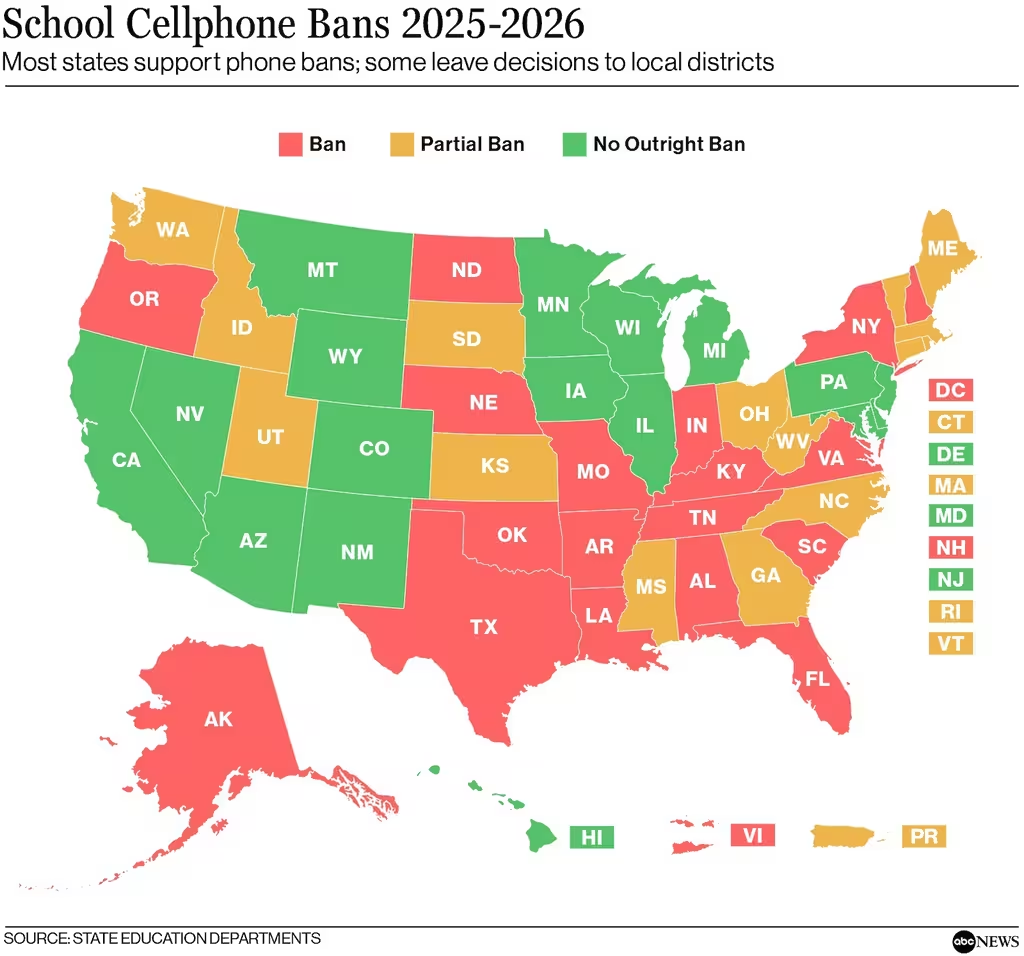
Many states have chosen to address minor online safety by working with school administrators to enact policy that governs device usage while on K-12 school campuses.


The states in red have a statewide ban on cell phones.  Generally, these states leave it to individual school districts to construct their own guidelines to comply with the policy.  The states in yellow have some stated policy and give more leeway to school districts to shape their cell phone policy.  


Once the policy is set, it is up to the school districts, school administrators, principals and teachers to enforce the policy.