
When it comes to federal legislation that addresses online safety for minors, the Children's Online Privacy Protection Act (COPPA) is the law of the land
L
Section 230 originated as part of a law that went into effect in 1996, the Communications Decency Act (CDA)
IN THE SENATE:
In October 2025, Senator Hawley introduced S.3062 - "Guidelines for User Age-verification and Responsible Dialogue" Act, or the GUARD Act
For a summary of the proposed GUARD Act, text of the bill, actions on the bill, and other details of the bill, click here:
www.congress.gov/bill/119th-congress/senate-bill/3062/text/is?overview=closed&format=xml
In June 2025, Senator Edward Markey (D-MA) introduced S.836 "Children's and Teens Online Privacy Protection Act" (COPPA 2.0)
For a summary of most recent COPPA 2.0 bill, text of the bill, actions on the bill, and other details of the bill, click here:
In May 2025, Marsha Blackburn (R- Tenn) re-introduced S.1748 -"Kids Online Safety Act" (KOSA)
For a summary of the Senate KOSA bill, text of the bill, actions on the bill, co-sponsors, and other details, click here:
S.1748 - 119th Congress (2025-2026): Kids Online Safety Act | Congress.gov | Library of Congress
In The House Of Representatives:
In April 2024, Representative Gus Bilirakis (R-FL) introduced H.R. 7891 - "Kids Online Safety Act"
For a summary of Bilirakis's bill, text of the bill, actions on the bill, co-sponsors, and other details, click here:
H.R.7891 - 118th Congress (2023-2024): Kids Online Safety Act | Congress.gov | Library of Congress
Let your opinion on these bills and other bills be heard by sending feedback to your Senator and House of Representative.
Call their offices, email them, or snail mail them.
The link to find and contact your Senator/Representative can be found in this website under the "Find Your Representatives" tab.
Click here to review how a Federal bill becomes the law of the land: www.congress.gov/legislative-process
Many states have chosen to address minor online safety by working with school administrators to enact policy that governs device usage while on K-12 school campuses.
Below is a map showing the various policies in the US. What is happening in your state?
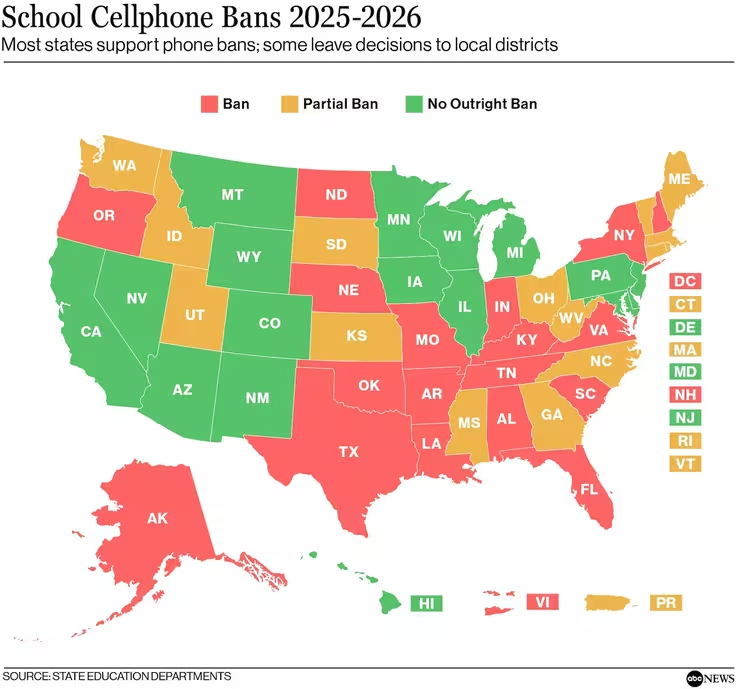
The states in red have a statewide ban on cell phones.
Generally, these states leave it to individual school districts to construct their own guidelines to comply with the policy.
The states in yellow have some stated policy and give more leeway to school districts to shape their cell phone policy.
Once the policy is set, it is up to the school districts, school administrators, principals and teachers to enforce the policy.